PDF Sprint
- 3.4
- Rating
- 100.00K
- Installs
- Free
- Price
 Analysis by App-foxy
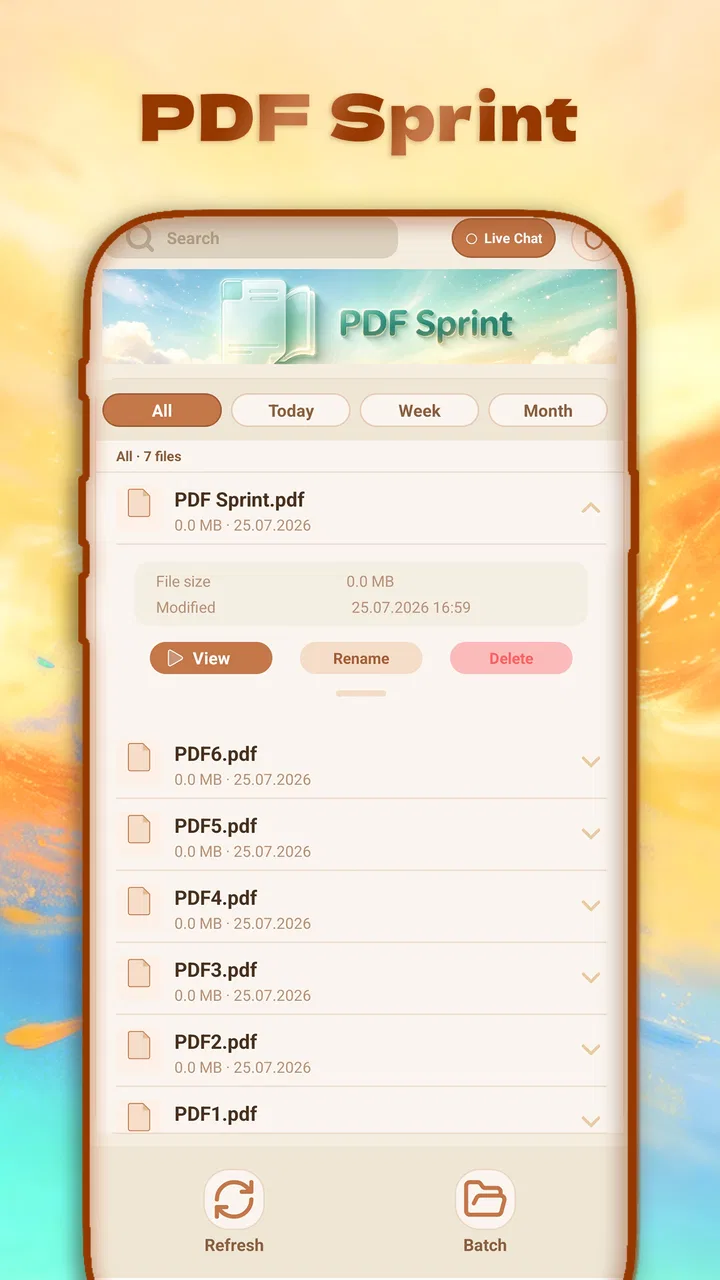
I tried PDF Sprint as a straightforward reading tool, and my first impression was that it aims at one very specific problem: making PDF reading feel less like an administrative task. Its store summary promises convenient reading, while the short description keeps the idea even simpler: “PDF Sprint.” That narrow focus is useful because the app does not need to compete with every document, note-taking, or office suite feature at once.
In my experience, the best reason to consider it is not that it replaces every PDF app. It is that a lightweight reader can make a shared phone or tablet easier to use when several people need to open documents during the day. A recipe, school handout, instruction manual, travel document, or household form can all live in the same general space without requiring a full productivity suite. The important question is whether that simplicity fits your routine.
How PDF Sprint fits into a shared household device
Imagine a tablet kept in the kitchen or living room. One person uses it to read a delivery instruction, another checks a school worksheet, and someone else opens a document needed for an appointment. In that situation, PDF Sprint makes sense as a common reading destination rather than as a personal document-management system. The appeal is immediate access: open the reader, choose the document, and get on with the reading.
You May Also Like

 Blood Strike: 2.5 Anniversary
Blood Strike’s Loadouts Turn Every Drop Into a Tactical Gamble
A close look at Blood Strike’s custom loadouts: how fast access to signature weapons reshapes its battle royale rhythm, rewards preparation, and narrows the gap between fights.

 Pandora - Music & Podcasts
Pandora’s Music Is Easy to Start, but Harder to Recover
Pandora’s strength is its low-effort path from a seed to a station. Its weak spot is how much confidence it asks you to place in connection, setup, and quiet recovery.

 8 Ball Pool
 Is Built on Rivalries, Rematches, and Routine
A close look at the rivalries, rematches, shared routines, and unanswered safety questions that turn a quick pool match into a persistent mobile community.

 Samsung Music
’s Quiet Strength Is Playing What You Already Own
Its reach comes less from spectacle than from dependable access to a personal library. That simplicity is both the app’s strongest retention engine and its ceiling.

 AccuWeather: Weather Radar
AccuWeather Review: A Quick, Clear Forecast for Everyday Decisions
For everyday plans, the best forecast is the one you can understand quickly. AccuWeather makes rain timing, radar, and local conditions easy to act on, with a few trade-offs.

 Hill Climb Racing
Why Hill Climb Racing Still Turns Crashes Into One More Run
A tiny car, a bumpy hill and one more upgrade: Hill Climb Racing keeps resurfacing because its simple chaos makes every near-miss feel personal.
More From Our News Desk



That shared-device scenario also exposes the app’s limits. A household reader is not the same thing as a family account system. I would not treat it as a place to separate private documents, enforce individual profiles, or manage children’s access. If the device is used by several people, the responsibility for folders, screen locks, and document organization remains with the household. PDF Sprint can support shared reading, but it should not be mistaken for a complete privacy or family-management solution.
The app is free, which lowers the barrier to trying it on an Android device. It is listed for Everyone, so its basic positioning is broad and suitable for ordinary household reading. That age label does not remove the need for adult judgment about the documents stored on a shared device. A PDF may contain personal information even when the reading app itself is appropriate for all ages.
Starting with a clean reading routine
When I use a reader on a shared device, I prefer to establish a simple routine before adding documents. I keep general-interest files in one easy-to-find location and place personal or sensitive material elsewhere, protected by the device’s existing security. That approach matters more with a basic reader because convenience can encourage people to leave files visible in the most obvious folder.
PDF Sprint is best approached as the reading layer, not the entire filing cabinet. I would first decide who owns the device, who may add files, and whether documents should be removed after use. This is especially helpful for temporary items such as a school form, a return label, or a printed instruction converted into PDF. Deleting finished documents reduces clutter and prevents the next user from opening something that was never meant for them.
A practical trick is to rename files before opening them in the app. Names such as “washing-machine-guide” or “math-practice-week” are easier to recognize than camera-generated filenames. This is not a special feature of the reader, but it makes the experience much smoother because the app can only show the files it is given. Good preparation has a noticeable effect on a simple PDF workflow.
What setup boundaries matter most
The current version is 1.0.1, and the minimum operating-system requirement is Android 10. That makes compatibility an important first check, especially if the household tablet is older or no longer updated. I would verify the device version before planning to move a large collection of documents onto it. A reader that cannot be installed on the intended shared device is not useful, however appealing the workflow sounds.
The developer is Dian Wu, and the app has reached over one hundred thousand installs. Its average rating is 3.7 from roughly two hundred and fifty ratings, with about twenty-five written reviews. I read those numbers as a sign of a modestly established utility rather than a universally trusted standard. The rating is not poor enough to dismiss the app, but it does encourage a trial with a few ordinary files before making it the household’s only PDF reader.
My setup advice is deliberately conservative. Install it on the device where it will actually be used, test a few PDFs of different lengths, and confirm that the reading experience feels comfortable for the people who will share it. If a document is important, keep another copy in its original location. A reading app should not become the only place where an essential form, manual, or reference file exists.
Coordinating documents without pretending there are profiles
Shared use works best when everyone follows the same small set of habits. I would give each regular user a clear place to put documents, avoid leaving several copies with nearly identical names, and agree on when temporary files should be removed. These rules sound ordinary, but they prevent the most common shared-device confusion: nobody knows which version is current, and nobody knows whether a file is safe to delete.
For a family, coordination may be as simple as announcing, “The new school worksheet is in the shared reading folder.” For housemates, it might mean keeping personal forms out of the common area entirely. PDF Sprint can be useful in both cases because its role is easy to understand. It is there to read PDFs, not to become a complicated collaboration hub.
That simplicity is also a trade-off. If your work depends on comments, tracked changes, signatures, document editing, or simultaneous collaboration, I would choose a more specialized office or cloud-document tool. A dedicated PDF reader is usually better for consuming information than for changing it. Trying to force a reading-focused app into an editing workflow can create unnecessary steps and confusion.
Another useful boundary is deciding who handles downloads and file transfers. On a shared tablet, one person can collect documents while others only open them, or everyone can manage their own files if the device is personal enough for that arrangement. The right choice depends on trust and the sensitivity of the documents. The app does not replace that household decision; it simply gives everyone a place to read the result.
Age, trust, and the meaning of “Everyone”
The Everyone content rating makes PDF Sprint approachable for households with mixed ages. A child can use a reader for homework, a teenager can review a timetable, and an adult can consult a manual. Still, the rating describes the app’s general audience, not every PDF that someone might open through it. A document can contain mature, private, or financially sensitive material even when the reader itself is suitable for general use.
I would therefore separate age suitability from document trust. Younger users may be perfectly capable of reading a worksheet, but they may not know which files should remain private or which downloaded documents are reliable. On a shared device, adults should explain the difference between opening a known school file and opening an unfamiliar attachment. That guidance is more valuable than assuming the app can make the judgment automatically.
The same applies to account boundaries. If several people use one device, I would avoid treating a common document area as a private account. Personal medical paperwork, identity documents, financial statements, and work files deserve a more controlled location. PDF Sprint can be part of the reading process after the file is safely stored, but it should not be the household’s answer to every privacy concern.
For a child’s reading routine, I like the idea of keeping only the current materials available. A parent can place the week’s worksheets in a clearly named folder, let the child read them, and then archive or remove them later. This reduces accidental exposure to unrelated documents and teaches useful file habits. It is a simple workflow, but it is more realistic than expecting a lightweight reader to provide elaborate family controls.
Everyday uses where the focused approach helps
One of my favorite use cases is a household instruction folder. Instead of searching through email while standing beside an appliance, I can keep the relevant manual as a PDF on the shared tablet. The reader’s value in that moment is not advanced document management; it is reducing friction between needing information and seeing it on screen.
It can also work well for recurring reference material. A family might keep a school calendar, a community notice, a public-transport guide, or a cooking document in one place. A small business or volunteer group could use the same approach for printed procedures that people mainly need to consult rather than edit. In each case, the app earns its place by making reading a repeatable habit.
A less obvious use is preparing a device for offline reading before leaving home. If the necessary PDF is already stored locally, a focused reader can be more convenient than opening a browser, signing into a service, and searching through several screens. I would still test the files before departure, particularly when the document is needed for travel or an appointment. Convenience is helpful only when the document is actually available at the moment it matters.
Another useful workflow is the “one task, one document” session. Rather than opening a large collection and losing track of what matters, I choose the PDF connected to the immediate task, read it, and close or remove it afterward. This keeps a shared device calmer and makes it easier for the next person to understand what is available. It also suits the app’s focused identity better than trying to turn it into a full digital archive.
Where alternatives are the smarter choice
I would choose PDF Sprint over a heavyweight office suite when my main need is simply reading a PDF without carrying along editing tools I will not use. A full office package may offer more capabilities, but those capabilities can add visual clutter and make a shared tablet feel less approachable. For quick reference, a focused reader is often easier to explain to another household member.
On the other hand, I would choose a cloud-centered document service when several people need synchronized access across separate phones, tablets, and computers. I would also look for a stronger document-management option when search across a large archive, annotations, signatures, or organized sharing are central to the job. PDF Sprint is not the right choice merely because the file extension happens to be PDF; the surrounding workflow matters more.
There is also a difference between a personal reading app and a shared-device utility. On my own phone, I may accept a more flexible tool that connects reading with notes and storage. On a family tablet, I may prefer the narrower purpose because fewer buttons mean fewer accidental changes. The trade-off is that the shared approach depends heavily on sensible file organization and device-level privacy.
The rating of 3.7 suggests I should keep expectations measured. I would not install it and immediately migrate every important document. I would use a small test set first: a short text-heavy PDF, a longer document, and a file with images or unusual formatting. If those behave comfortably on the target device, the app may be a good fit for everyday reading. If the household needs more than reading, a different category of tool will likely save time.
My household verdict after weighing the trade-offs
PDF Sprint is a sensible candidate for people who want a free, focused way to open and read PDF files on an Android device running Android 10 or later. I especially like its potential on a shared tablet where the goal is to make reference documents easy to reach without introducing a complicated office environment. Its Everyone rating also makes the basic app approachable for mixed-age use, provided adults still manage document privacy and trust.
I would recommend it to a household that can agree on simple file rules: clear names, sensible folders, limited temporary storage, and no assumption that a shared reader creates separate personal spaces. I would also recommend testing it before relying on it for important documents, because the 1.0.1 release and its moderate user rating make a personal trial worthwhile.
I would skip it if the real requirement is editing, signing, annotating, synchronizing across many accounts, or protecting separate collections for different users. In those cases, a more complete PDF or document platform is a better match, even if it feels heavier. PDF Sprint’s strength is its narrow purpose, and that same narrowness is the reason it should not be stretched beyond reading.
My final view is positive but practical: PDF Sprint works best when the household treats it as a shared reading window, not as a private filing system or collaboration suite. Used within that boundary, it can make everyday documents easier to consult and easier to coordinate. Used without those boundaries, the app cannot solve the organizational and privacy problems that come with sharing one device.
FAQs for PDF Sprint
01What is PDF Sprint and what can I use it for?
PDF Sprint is a productivity tool designed to help users work with PDF documents more efficiently. Depending on the available version and features, it may support tasks such as opening, reading, organizing, sharing, or managing PDF files. It is useful for students, office workers, and anyone who regularly needs to access documents on a mobile device without relying on a desktop computer.
02Is PDF Sprint free to download and use?
PDF Sprint may be available as a free download, but some functions can depend on the app’s pricing model, subscription options, or in-app purchases. Before installing it, check the official Google Play Store or Apple App Store listing for current details about premium tools, advertisements, trial periods, and recurring charges. Reviewing this information first helps avoid unexpected costs.
03Can PDF Sprint open and manage PDF files stored on my phone?
The app is intended for working with PDF documents on a mobile device, so users should be able to access compatible files through the app or their device’s file-sharing menu. Available options may include browsing, opening, saving, or sharing documents. File access can vary by Android or iOS permissions, so the app may request storage or document access when first used.
04Does PDF Sprint work offline, or does it require an internet connection?
Basic PDF viewing and document access may work without an internet connection once the files are already stored on your device. However, features involving cloud storage, online conversion, synchronization, account verification, advertisements, or downloading documents may require mobile data or Wi-Fi. If offline access is important to you, test the app with a locally saved PDF before depending on it while traveling.
05Is PDF Sprint safe to install and suitable for private documents?
Before using PDF Sprint for contracts, identification documents, financial records, or other sensitive files, review its official privacy policy and the permissions requested during installation. Avoid assuming that every document is encrypted or protected automatically. Download the app only from a trusted store, keep your device updated, and use extra caution when sharing PDFs or connecting the app to cloud services.
Pros
- Quickly opens and renders most standard PDF documents.
- Simple interface makes basic reading tasks easy to understand.
- Useful search function helps locate words or phrases in documents.
- Supports convenient zooming for viewing small text and details.
- Lightweight design may work well on devices with limited storage.
Cons
- Advanced editing and annotation tools may be unavailable or limited.
- Some PDFs with complex layouts may not display perfectly.
- Free use may include advertisements or prompts for premium features.
- Large documents can take longer to load on older smartphones.
- Privacy details should be checked before opening sensitive documents.

PDF Sprint
Gallery